Shari Creates

Books, languages, things I make and notes from everyday life.

Tag: Language learning

  • How Building a Malay Learning Resource Became My New Hobby

    How Building a Malay Learning Resource Became My New Hobby

    Daily writing prompt
    Share a hobby you’ve picked up recently — what got you into it?
    Rainy Malaysian street scene with a woman holding an umbrella near a kedai runcit

    I don’t think I consciously decided to pick up a new hobby. It just happened.

    A few weeks ago, I started working on a small website called BacaMalay. The name is meant quite literally: baca means “read” in Malay, and BacaMalay is pronounced roughly BA-cha ma-LAY — the c in Malay sounds like ch. The idea was fairly simple: create a Malay learning resource for people who want reading material that feels more interesting than textbook dialogues.

    At first, I thought I would simply put together some graded readings. Then I found myself writing stories.

    I started thinking about which words a beginner would realistically know, how much new vocabulary is too much, whether a sentence sounds genuinely Malay rather than something translated from English, and how to explain little cultural things that Malaysians would normally never think to explain.

    Then came the folklore.

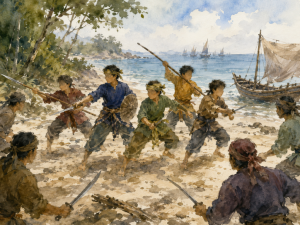
    Sang Kancil — the mouse deer — led to more Sang Kancil. Then Hang Tuah and Hang Jebat appeared. Suddenly I was planning chapters, choosing illustrations and thinking about how an old story could be made accessible without turning it into a children’s story.

    It has become strangely absorbing.

    What I enjoy most is probably the combination of things involved. There is writing, language, research, design and a little bit of problem-solving. One moment I’m working out whether a word belongs at Beginner or Elementary level; the next I’m trying to decide how much cultural explanation a reader actually needs.

    Even the illustrations have become part of the process. I wanted the site to feel recognisably Malaysian, so ordinary things — a rainy street, a kedai runcit (neighbourhood grocery shop), a bus stop, a burger stall — matter just as much as the stories themselves.

    What began as an attempt to build a useful Malay learning resource has quietly turned into something I genuinely enjoy working on.

    I’m still not entirely sure whether I should call BacaMalay a hobby, a project, or an experiment.

    For now, perhaps it is all three.

  • Why I Started BacaMalay

    BacaMalay actually began because of my husband. He had picked up an interest in learning Malay again, and that got me thinking about what was available for someone who wanted to learn the language. At around the same time, I had also been thinking about starting some kind of project of my own.

    And there was another feeling mixed into it: nostalgia. I missed reading Malay. Not necessarily studying it or analysing grammar. I missed simply reading things written in Malay — stories, expressions, conversations and the kind of writing that had once been an ordinary part of my life.

    The idea of graded reading wasn’t something I invented. I already knew it from learning Mandarin. I had used sites such as Mandarin Bean, HSK Online and Du Chinese. Mandarin Bean and HSK Online offer lessons as well, while Du Chinese is much more focused on reading, but all of them had introduced me to the idea of reading material organised according to language level.

    So I started wondering what existed for Malay. There are certainly Malay learning resources. There are books, lessons, folktales, school materials and stories scattered around the internet. But I wanted something quite specific.

    What if someone simply wanted to read Malay? Not another grammar lesson. Not a page of comprehension questions. Just something interesting to read. And preferably something chosen according to how much Malay they could already understand.

    Then, one weekend in early August, more or less on a whim, I paid for a domain and started building it. That domain became BacaMalay.

    And just in case you have been reading that as BakaMalay in your head: baca is pronounced roughly bah-cha. In Malay, the letter c has a “ch” sound. Baca means “read”, so BacaMalay is quite literally an invitation to read Malay.

    I had an idea, inspiration from the Mandarin resources I had used myself, a free weekend and enough curiosity to see what I could make. The structure gradually became Beginner, Elementary, Intermediate and Advanced readings.

    But while I was thinking about what stories should actually go into this library, something happened that I hadn’t really expected. I started remembering things.

    Lebai Malang — the unfortunate religious teacher. Pak Pandir — the foolish but memorable character of Malay folktales. Badang — the legendary strongman.

    Hang Tuah and his companions

    Sang Kancil. Hang Tuah. Hang Jebat. Stories and characters that had once been familiar suddenly began resurfacing in my memory. Some I remembered clearly. Others I realised I had almost completely forgotten.

    And I was happy to become acquainted with them again. That made me even more excited about BacaMalay. It was no longer only about producing reading material for someone learning Malay. I was also rediscovering something myself.

    I began looking again at stories I had not thought about for years and remembering just how rich the collection of Malay folktales, legends and comic characters actually is. I wanted BacaMalay to have room for all of that.

    There could be ordinary contemporary stories — waiting for a bus, buying food on the way home, drinking coffee, going to work. But there could also be Sang Kancil tricking his way out of trouble, Pak Pandir making another terrible decision, stories about Badang and his extraordinary strength, and eventually many more of the stories that Malaysians have passed down for generations.

    I wanted the site to feel recognisably Malaysian rather than like a collection of generic language-learning dialogues that happened to be written in Malay.

    Building it has also made me notice things about my own language that I would normally never stop to explain. What exactly are we communicating when we call someone Bang? Why does bungkus immediately make sense when ordering food to take away? What picture comes into a Malaysian person’s head when someone says kurus macam lidi — skinny like the thin rib of a coconut-palm leaf?

    These are tiny things. But when you are writing for someone who didn’t grow up knowing them automatically, you suddenly have to think about what they mean and why we say them.

    And yes, I use AI quite a lot while building BacaMalay. There isn’t much point pretending otherwise. I use it for brainstorming, research, organising ideas, developing stories and solving the technical problems that inevitably appear when I decide I want the website to do something new.

    But I also write. I edit. I change things. I reject suggestions. I argue over words and expressions. Sometimes I rewrite a sentence several times because it doesn’t sound quite right to me.

    The technology makes it possible for me to build much more than I could have built alone, particularly in such a short time. But the choices about what BacaMalay should become are still mine.

    Where will it lead? I genuinely don’t know. Perhaps people will find it and use it. Perhaps it will eventually make some money. Perhaps it will remain a rather obscure little corner of the internet.

    For now, though, it keeps me occupied, and I enjoy building it. There is always another story I suddenly remember, another one I discover again, another expression worth explaining, or another part of the site I want to improve.

    And sometimes I think much further ahead. If I keep adding to it over the years, BacaMalay could eventually become quite a substantial collection of Malay stories, legends, everyday language and bits of culture.

    Maybe one day my grandchildren will come across it. I have no idea whether they will need BacaMalay to learn the language. I don’t even know what the internet will look like by then.

    But there is something rather nice about the possibility that they might one day be able to look through all those stories and know: Their grandmother made this. Ha ha

    Not bad for something that started with my husband learning Malay, a bit of nostalgia, and me impulsively buying a domain one weekend in August.

  • My First Mandarin Words Weren’t 你好

    It was the 1980s, and I remember afternoons in Johor Bahru when television was still something you had to wait for. Channels weren’t broadcasting twenty-four hours a day. They started at particular times, sometimes in the morning, sometimes around noon or later. At that age, I couldn’t properly tell the time yet, but I could read numbers and I knew what the clock was supposed to look like. When the short hand pointed towards 3 and the long hand pointed towards 12, I knew it was time to turn on the television.

    My mother had this huge Singer colour TV. At least, it seemed huge to me then. We could receive Singapore television from Johor Bahru, and I watched quite a lot of it. If I remember correctly, Channel 5 was mainly the English-language channel while Channel 8 had much more Chinese programming.

    I actually learnt a surprising amount from television. I learnt to read partly from watching Sesame Street. But at the same time, without anyone deliberately teaching me, I was also absorbing bits and pieces of Mandarin from Singaporean Chinese dramas.

    And apparently national anthems. I learnt to sing Majulah Singapura before I learnt Negaraku. 😂

    For anyone unfamiliar with this little Malaysia-Singapore oddity, Majulah Singapura, meaning “Onward Singapore”, is Singapore’s national anthem. Negaraku, meaning “My Country”, is Malaysia’s national anthem. I was Malaysian and living in Johor Bahru, yet somehow I learnt Singapore’s anthem first.

    The Singapore television channels would play it when broadcasting began and ended, and after hearing it over and over again, I simply learnt it. I can still sing Majulah Singapura today.

    Apparently repetition works. It also worked on my Mandarin.

    My first Mandarin words were not 你好

    When people start learning Mandarin now, one of the first things they usually learn is:

    你好
    nǐ hǎo
    Hello.

    That was definitely not how Mandarin entered my vocabulary. My first Mandarin words were considerably more dramatic.

    The Singapore channels showed a lot of Chinese dramas. I remember period dramas, kung fu, people fighting with swords and, naturally, people somehow flying from tree to tree. And because television dramas apparently involved a great deal of kidnapping, fighting and general emotional distress, some of the sounds that stuck in my head were things like:

    救命啊!
    jiùmìng a!
    Help!

    放开我!
    fàngkāi wǒ!
    Let go of me!

    And another sound I remembered for years, which I only understood properly much later:

    求求你呀!
    qiúqiu nǐ ya!
    Please! / I’m begging you!

    Very practical vocabulary for a small child. 😂

    At the time, of course, I didn’t know the characters, the pinyin or even exactly what I was hearing. I just remembered the sounds. Years later, after I began studying Mandarin properly, some of those old fragments suddenly became recognisable.

    “Oh. THAT is what they were saying.”

    There is something very strange about discovering that words you are supposedly “learning” have actually been sitting somewhere in your memory for decades.

    The Samsui Women

    One drama that stayed particularly strongly in my memory was Samsui Women — 红头巾, literally “The Red Bandana” (Wikipedia). I remembered it as an incredibly long and rather sad drama.

    Looking it up now, I discovered that it was only 24 episodes. Twenty-four! In my childhood memory, these women appeared to spend half their lives on television. 😂

    The drama followed Samsui women who came from Sanshui in China to Singapore looking for work, particularly in the construction industry. They became known for their distinctive red headscarves and for the physically demanding work they did during Singapore’s development.

    What I remembered, though, was not historical information. I remembered women getting older. I remembered hardship. I remembered that it felt sad.

    I remember following some of these women from when they were young until they were much older, and I vaguely remember deaths as well, although after all this time I certainly wouldn’t trust myself to reconstruct the plot episode by episode.

    I was fascinated to learn much later that these were stories connected to real women who had helped build Singapore. The production itself apparently tried to speak with actual Samsui women while researching the drama, although many had already moved away from the places where they had once lived and some were reluctant to talk about their past.

    None of this was something I understood while watching it. I didn’t need to. I understood enough to know that what was happening mattered.

    Perhaps that is another reason Mandarin stayed with me. Long before I understood the language, I had already learnt that emotion could come through it.

    Mandarin grew on me before I learnt it

    When I look back now, I don’t think there was one moment when I suddenly decided that I liked Mandarin. It grew on me. Or perhaps it grew in me.

    First there were sounds coming from a television in Johor Bahru. Then there were strange words I remembered without knowing why. There were Chinese period dramas and kung fu and people flying through trees. There was Samsui Women. There were years in between. And eventually there was me, as an adult, actually sitting down and learning Mandarin.

    Maybe that also explains something about the way I learn languages now. I live in Hungary, but I hardly watch Hungarian television. To be completely honest, I don’t even really know how Hungarian television works these days because I simply don’t watch it. Perhaps that partly explains why Hungarian does not seem to sink into my brain as easily.

    Mandarin, meanwhile, is everywhere because I keep putting it everywhere. I take Mandarin lessons. I watch Chinese dramas. I watch Chinese videos. I read things in Chinese. I look things up. I listen to people speaking it.

    The amount of Mandarin I deliberately consume is sometimes slightly ridiculous. If you looked only at my media habits, you might think I was somewhat delusional and had convinced myself that I lived in China rather than Hungary. 😅

    But perhaps I am simply recreating something that happened naturally when I was a child. Back then, Mandarin came through the television whether I understood it or not. Now I am the one turning it on.

    And after all these years, my first Mandarin words still weren’t 你好. They were basically:

    HELP! LET GO OF ME! I’M BEGGING YOU!

    Which, considering the Chinese dramas I grew up watching, feels entirely appropriate.

  • Talking About Drought, Yoghurt and Hot Springs in Mandarin

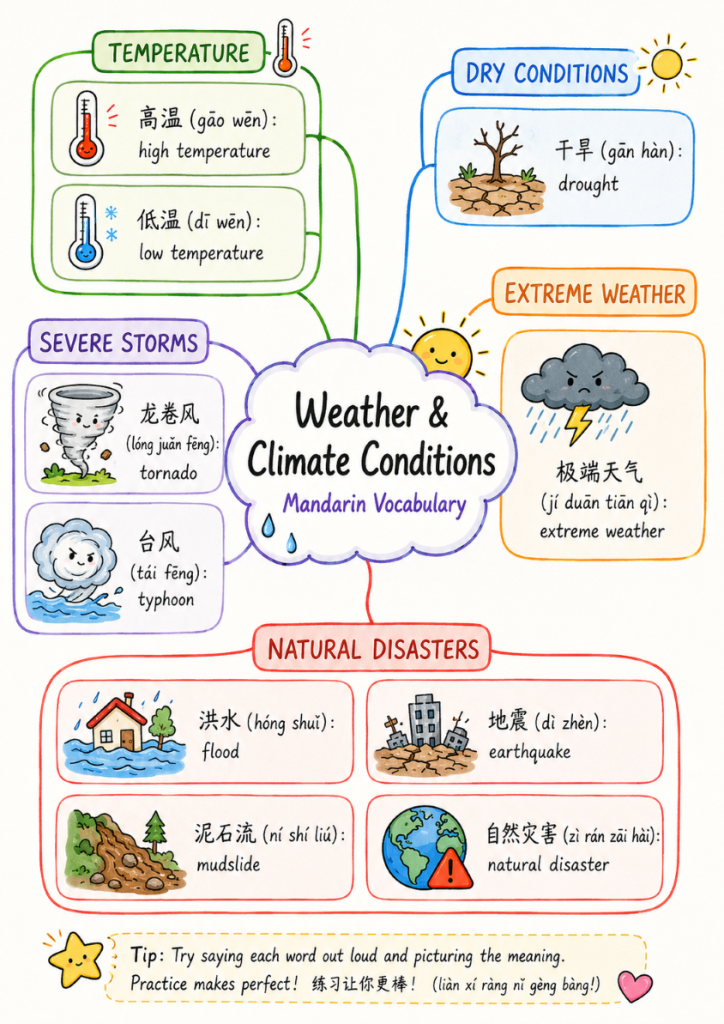
    On 11 August, I had another Mandarin speaking lesson with Yufan on Preply. Our main topic was 自然灾害 (zìrán zāihài) — natural disasters.

    The topic was surprisingly relevant because Hungary has been very dry lately.

    I told Yufan:

    匈牙利干旱,很久没下雨了。
    Hungary is experiencing drought, and it hasn’t rained for a long time.

    We also talked about the Danube:

    多瑙河的水位下降了。
    The water level of the Danube has fallen.

    There were already several new words for me here.

    干旱 (gānhàn) — drought
    水位 (shuǐwèi) — water level
    下降 (xiàjiàng) — to fall, decrease
    干涸 (gānhé) — to dry up

    Mandarin lesson vocabulary mind map from 11 August 2026

    Then we moved on to the heat.

    I told Yufan:

    上个星期最高温度是41度。
    Last week, the highest temperature was 41°C.

    She was surprised. She hadn’t expected Hungary to get that hot.

    This week, however:

    这个星期降温了,现在最高温度是35度。
    This week it has cooled down. Now the highest temperature is 35°C.

    Another useful word:

    降温 (jiàngwēn) — for the temperature to fall; to cool down

    We talked about what people should do when the temperature suddenly drops:

    突然降温应该做什么?
    What should you do when the temperature suddenly drops?

    That brought us to 预防感冒 (yùfáng gǎnmào) — preventing a cold — and things like 多喝热水drinking hot water , 多吃含有vitamin C的食物 eating food containing vitamin C  and 穿适合的衣服 wearing suitable clothes.

    I asked whether Chinese say 喝药 “drink medicine” or 吃药 “eat medicine” because in Japanese I know they say 薬を飲みます (kusuri o nomimasu), literally “drink medicine.” To which she said: 看情况 – it depends. It depends on the form. Somehow this led to learning the words:

    液体 (yètǐ) — liquid
    固体 (gùtǐ) — solid

    And this was probably one of my favourite little discoveries from the lesson.

    We started talking about yoghurt.

    In Chinese, it is very common to say:

    我喝酸奶。
    I drink yoghurt.

    Yufan explained that 喝酸奶 (hē suānnǎi) is commonly used even when the yoghurt is quite thick. 吃酸奶 (chī suānnǎi) is also used, especially when yoghurt is treated more obviously as something spoonable, but 喝酸奶 is a very normal expression.

    I found that particularly interesting because we had just been talking about 液体 and 固体. Whether the yoghurt seems more liquid or more solid does not necessarily determine which verb Chinese speakers naturally use.

    我觉得很有意思。 😄

    We also practised:

    室内 (shìnèi) — indoors
    室外 (shìwài) — outside
    户外 (hùwài) — outdoors

    and the sentence:

    不要长时间待在户外。
    Don’t stay outdoors for a long time.

    From there the conversation wandered even further.

    We somehow ended up talking about 温泉酒店 (wēnquán jiǔdiàn) — hot spring hotels — including rose baths, green tea baths, milk baths and medicinal baths.

    And eventually we went back to the topic of 自然灾害 natural disasters again. 

    Wrapping up with the question of whether my country had ever experienced 火山爆发 (huǒshān bàofā) — volcanic eruption.

    So what began as a conversation about natural disasters somehow travelled from drought in Hungary, to the Danube, 41-degree weather, sudden temperature changes, yoghurt, staying indoors, hot springs and finally volcanoes.

    That is actually what I like about these speaking lessons. I never quite know where the conversation is going to go, and along the way I pick up words that I probably would not have deliberately chosen to study from a vocabulary list.


    (more…)