Shari Creates

Books, languages, things I make and notes from everyday life.

Category: Languages

  • HSKCourse.com Review: A Self-Learner’s Honest Take.

    HSK course

    I was given the opportunity to try out HSKCourse.com and after a little over two weeks, here’s my honest take. I’m just excited about it.

    Timing was good on my end. I’d been on a Mandarin hiatus for a while and needed to do some revision before getting back to my weekly speaking practice with a tutor on Preply earlier this month. So this came at the right moment.

    The site covers video courses from HSK 1 through 3. HSK 1 and 2 are fully complete. HSK 3 is still being added to, with 10 out of 20 lessons up so far and more on the way.

    What I liked

    Honestly, the best way I can describe it is: it feels like having a tutor sit with you and walk you through the material. The teacher has a calm, clear voice and explains things in a way that actually makes sense rather than just throwing information at you. For new lessons I’d sit down properly and pay attention. But for lessons I’d already covered? I’d put my headset on and let it play while doing housework, folding laundry, washing dishes. It held up as revision even without watching the screen, which says a lot.

    For HSK 3, each video lesson has four parts, each roughly 19 to 20 minutes. A full lesson is about 70 to 80 minutes if you do it all in one go, but you don’t have to. One part a day works just as well.

    The structure for HSK 1 and 2 is slightly different. HSK 1 starts with Pinyin and Hanzi sections before moving into the lesson content, while HSK 2 opens with a quiz. By HSK 3 the format shifts to four full lesson segments. It makes sense as a progression. Since I’m already at HSK 3 level, I only had a quick look through the earlier levels, but it’s good to know the structure adapts as you go.

    One thing I appreciated: he doesn’t just teach the language, he drops in bits of Chinese culture and daily life along the way. He’ll often explain something in Mandarin first, then repeat in English. After a while you stop waiting for the English part. That’s good training for the ears, and there are also plenty of HSK listening exercises throughout.

    The vocabulary section has a word list with audio for tones, plus a test at the end. The grammar section covers things clearly with quizzes built in after each topic, not as an afterthought but right there in the flow.

    A few extras worth mentioning: there’s a New HSK Vocabulary section organised by band level up to level 7-9 and the lists are downloadable. I went through the ones for my level and found it really convenient. The grammar section actually goes up to HSK level 5-6, so there’s more there than just what the video courses cover. And there are writing exercise sheets in PDF format, meant to be printed out for practice. I downloaded mine and used them on my iPad. Simple but useful.

    What could be better

    I’d love to see graded reader texts, short articles or dialogues with comprehension questions to go alongside the lessons. And for subscribers, some kind of progress tracker would be a nice perk. Right now there’s no way to see how much you’ve done or what’s left. You can track it manually, but some sort of indicator showing that a video has been watched would go a long way.

    Free access is limited. You get the first video segment per lesson and a partial look at the grammar section. Enough to get a feel for it, but you’ll need a subscription for the full thing.

    Is it worth it?

    I’ll be honest, it’s not meant to replace a tutor entirely, especially for speaking. But for self-learners who are already doing one lesson a week on Preply or iTalki or any platform for that matter, and studying the rest on their own? This is exactly the kind of resource that fills that gap. Not everyone can afford more tutor hours. Not everyone has the time. This lets you go at your own pace and actually understand the material, then use your tutor time for what it’s really for: speaking, not sitting through grammar explanations.

    Pricing: one year is $69, about $5.75 a month. Lifetime access is $119. At $5.75 a month, easy yes. For lifetime, it makes most sense if you’re starting from HSK 1 or 2. If they keep building out the higher levels, it’ll be worth it at any starting point.

    My final take? If I were starting over, I’d use HSKcourse.com to build my foundation: grammar, vocabulary, structure, and keep my tutor for speaking. That combination would have served me really well. I’m genuinely looking forward to the rest of HSK 3 and hopefully all the way up to HSK 6.

  • HSK 1-3 Character progress sheet

    I needed to do a bit of review on the Hanzi from HSK 1-3 and used Claude to help me create a list that I could track my own practice.

    Feel free to try it out.

  • Getting into Claude

    I’ve been experimenting with a bunch of AI tools lately – ChatGPT, Grok, Copilot, Gemini, and most recently Claude – and I have to say, I’m genuinely impressed.

    What I enjoy most is that even without being a coder, you can still create surprisingly polished “artifacts” like this one. I’ve been generating a few comprehension texts for myself, and while I can’t fully guarantee the accuracy of the grammar, the results look great to me.

    What do you think?

  • My Du Chinese Experience: Two Years and Counting!

    Du Chinese Logo

    I’ve been using Du Chinese for the past two years, and it’s been an incredible journey! I initially took advantage of the Black Friday sale and snagged a subscription at 50% off, which was an amazing deal. I’m seriously considering getting the lifetime subscription with one time payment. They usually offer this during the Mid-autumn or Black Friday sale.

    For those who are new to Du Chinese, here’s a quick overview of their pricing plans:

    • Monthly Plan: $14.99 USD
    • 6-Month Plan: $79.99 USD (usually $89.94, saving you 11%)
    • 12-Month Plan: $119.99 USD (usually $179.88, saving you 33%)

    Du Chinese offers a variety of lessons, from beginner to master level, and is perfect for improving your Chinese reading skills. The app is available on both mobile and desktop, making it easy to learn on the go or at home.

    I’m currently delving into the intermediate and upper intermediate level articles and stories. I recently finished the classic tale of “Hua Mulan” and am following the captivating series “Digital Dad” and the “Witches’ Loaves”. What I love about the app is that it offers both reading and audio options. I can listen to the audio while I read, which really enhances my comprehension. There is also an option where you can add new words to a flashcard to memorize later. I honestly don’t use this feature. I prefer to read more often to see the words and assimilate that way.

    Mobile_DarkMode_Duchinese

    With the audio option, you can even listen to a story continuously like an audiobook, allowing you to practice your listening skills without reading.

    Mobile_DarkMode_Duchinese_audio

    One downside I’ve encountered with the app is that navigating through the stories, especially the older ones, can be a bit challenging. It would be fantastic if they could introduce a filter by years to make it easier to find specific content. That being said, the web version does offer a slightly more user-friendly navigation experience.

    If you haven’t tried Du Chinese yet, I highly recommend it. It’s a fantastic tool for anyone looking to improve their Chinese language skills. Have you tried Du Chinese, or are you considering giving it a go?

    Thanks for reading!

  • Ai generated lessons for learning mandarin.

    I am rather new to Ai. But hey, it’s better late than never. 🙂 I’ve been studying Mandarin Chinese a while now, so I thought why not integrate my learning a language with Ai. And I want to share with you how I used AI to create stories for learning Mandarin.

    As you may know, Mandarin Chinese is a very challenging language to learn, especially for English speakers. It has a different writing system, a different pronunciation system, and a different grammar system. Plus, there are so many words and expressions to learn, and so many cultural nuances to understand.

    That’s why I decided to use stories as a way to learn Mandarin. Stories are a great way to immerse yourself in the language and culture, and to learn new vocabulary and grammar in context. Stories can also make learning more fun and engaging, as you can follow the plot and the characters, and use your imagination and creativity.

    There are a few sites that I used for reading mandarin, however what started out of curiosity, it has become a way I used more and more since it is fun.

    AI, or artificial intelligence, is the technology that enables machines to perform tasks that normally require human intelligence, such as understanding language, generating text, and creating images.

    I found some amazing AI tools that helped me learn Mandarin through stories in several ways. Here are some examples of how I used AI tools to enhance my Mandarin learning experience:

    • AI story generator: I used an AI story generator to create stories based on my input. For example, I typed in a topic, a genre, a character, or a plot, and the AI generated a story for me. I then read the story and learned new words and sentences. I also used the AI story generator to practice my writing skills by continuing the story or rewriting it in my own words. Some AI story generators that I tried are Squib, [StoryAI], and [Storyteller].
    • AI story translator: I used an AI story translator to translate stories from English to Mandarin, or vice versa. For example, I found a story in English that I liked, and I used the AI story translator to translate it into Mandarin. I then compared the original and the translation, and learned how to express the same idea in different ways. I also used the AI story translator to check my own writing, and to correct any errors or improve any expressions. Some AI story translators that I used are [DeepL], [Google Translate], and [Microsoft Translator].
    • AI story illustrator: I used an AI story illustrator to create images based on my stories. For example, I wrote a story in Mandarin, and I used the AI story illustrator to generate an illustration for it. I then looked at the image and learned how to describe it in Mandarin. I also used the AI story illustrator to inspire me to write new stories, based on the images that the AI created. Some AI story illustrators that I experimented with are [Artbreeder], [VQGAN+CLIP], and [DALL-E].

    Using AI to create stories for learning Mandarin was a very rewarding and enjoyable experience for me. I felt that I improved my reading, writing, speaking, and listening skills, as well as my vocabulary, grammar, and cultural knowledge. I also had a lot of fun and creativity, as I explored different topics, genres, characters, and plots.

    Of course, AI is not perfect, and sometimes it made mistakes or generated nonsensical or inappropriate content. That’s why I always checked the AI output with other sources, such as dictionaries, grammar books, or native speakers. I also used other resources, such as apps, podcasts, videos, and books, to complement my learning.

    But overall, I think AI is a very powerful and useful tool for learning Mandarin through stories, and I highly recommend it to anyone who wants to learn Mandarin in a fun and effective way. If you are interested in trying it out, you can check out the links that I provided above, or search for other AI tools that suit your needs and preferences.

    I hope you enjoyed reading my blog post, and I hope you learned something new. If you have any questions or comments, please feel free to leave them below. Thank you for reading, and happy learning! 😊

    Here’s an example of a story generated with Ai.😊

    今天是星期天,李家一家人都在家里。李爸爸想做饭给大家吃,但是他不太会做饭。他去超市买了一些菜,但是他忘了买盐。他回家后,就开始做饭。他做了一盘鱼,一碗汤,和一些青菜。他把饭菜放在桌子上,叫大家来吃饭。李妈妈,李哥哥,和李妹妹都坐下来,拿起筷子,准备吃饭。他们先吃了一口鱼,然后都皱起了眉头。原来,李爸爸没有放盐,鱼很淡。他们又喝了一口汤,然后都吐了出来。原来,李爸爸放了太多的糖,汤很甜。他们再看了看青菜,发现青菜都是黑的。原来,李爸爸炒菜的时候,火太大,把青菜都烧焦了。李家一家人都不想吃饭了,只好去外面吃。李爸爸很尴尬,也很难过,他以为自己做的饭很好吃,没想到大家都不喜欢。他决定以后还是不要做饭了,让李妈妈做饭,或者去饭馆吃饭。

    The story has 50 words. Here are 10 HSK 3 vocabulary words from the story, with their English translations:

    做饭 (zuò fàn): to cook

    超市 (chāo shì): supermarket

    盐 (yán): salt

    鱼 (yú): fish

    汤 (tāng): soup

    糖 (táng): sugar

    青菜 (qīng cài): green vegetables

    炒 (chǎo): to stir-fry

    烧焦 (shāo jiāo): to burn

    饭馆 (fàn guǎn): restaurant

    Here are 5 comprehension questions about the story, with their answers:

    Q: 今天是星期几?(What day is it today?)

    A: 今天是星期天。(Today is Sunday.)

    Q: 李爸爸为什么想做饭?(Why does Li’s father want to cook?)

    A: 李爸爸想做饭给大家吃。(Li’s father wants to cook for everyone.)

    Q: 李爸爸做了什么饭菜?(What dishes did Li’s father make?)

    A: 李爸爸做了一盘鱼,一碗汤,和一些青菜。(Li’s father made a plate of fish, a bowl of soup, and some green vegetables.)

    Q: 李家一家人为什么不喜欢李爸爸做的饭?(Why does Li’s family not like Li’s father’s cooking?)

    A: 因为鱼很淡,汤很甜,青菜都烧焦了。(Because the fish is bland, the soup is sweet, and the vegetables are burnt.)

    Q: 李家一家人最后去哪里吃饭?(Where does Li’s family go to eat in the end?)

    A: 李家一家人最后去外面吃,或者去饭馆吃。(Li’s family goes out to eat, or goes to a restaurant.)

  • Navigating mandarin with Preply – A year in review

    Alright, so around July 2022, I decided to switch things up in my Mandarin learning routine and gave Preply a shot – the online tutoring gig. After flying solo in the world of Chinese characters for years, I figured it was time to bring in a real pro to help me out. Fast forward a year, and here’s the lowdown on how Preply’s been my wingman, helping me tackle HSK 3 and prepping for HSK 4 in the year ahead.

    Why Preply? Well, firstly, it won me over with its budget-friendly prices. Learning Mandarin on a dime? Preply’s got your back. The cost factor made it a logical choice for me to link up with a native-speaking tutor without draining the wallet.

    So, every weekend, I’ve been hanging out with my tutor for about an hour per session. The pocket-friendly nature of Preply allowed me to stick to this routine, making my Mandarin learning journey feel like a walk in the park. My tutor, the Mandarin maestro, has been guiding me through the language labyrinth, giving me structured lessons and, most importantly, helping me get the hang of conversations.

    Oh, and did I mention I aced HSK 3 with my tutor? Yep, no official exams yet, but the mock exams were smooth sailing. Looking ahead, I’ve got my eyes on HSK 4 like it’s the next challenge. This time I’m going for the real exam, the one in July.

    And let’s talk about the practical side – talking! Preply isn’t just about lessons; it’s about real-life convos. Even if, with my tutor, I’m just reading from the lessons, but there are always opportunity to have simple conversations. It’s a much needed language workout – flex those speaking muscles, you know?

    In a nutshell, Preply’s tutor has been the reliable guide I needed in this Mandarin journey. From HSK 3 wins to gearing up for HSK 4, it’s been a journey. Props to my tutor and the reasonable pricing – you guys are the real MVPs. Looking forward to what the next year brings!

  • Uncovering a Mandarin Learning Gem: MandarinBean

    Embarking on a journey to learn Mandarin can be both thrilling and daunting, especially when faced with the myriad of resources available. Having relied on DuChinese for the past year, the recent price hikes left me in search of a more budget-friendly alternative that still delivered quality content. Enter MandarinBean—a hidden gem that has not only exceeded my expectations but has become an integral part of my Mandarin learning journey.

    Graded Reading Lessons: A Breath of Fresh Air

    One of MandarinBean’s standout features is its extensive collection of graded reading lessons spanning from HSK 1 to 6. Each lesson is meticulously crafted to cater to learners of varying proficiency levels. What sets MandarinBean apart is its engaging approach to teaching. The lessons, presented in a blog format, are not only informative but also intriguing, making the learning process enjoyable. It encourages interaction, allowing learners to comment and engage with each lesson, fostering a sense of community among Mandarin enthusiasts.

    The inclusion of both traditional and simplified versions of Hanzi, along with toggleable pinyin, provides a comprehensive learning experience. Whether you’re a beginner navigating the basics or an advanced learner seeking a challenge, MandarinBean’s graded reading lessons offer something for everyone.

    Grammar Points with Exercises: A Practical Approach

    Mandarin grammar can be a maze for learners, and MandarinBean excels at simplifying complex concepts. The platform seamlessly integrates grammar points with interactive exercises, allowing users to reinforce their understanding through practical application. This hands-on approach sets MandarinBean apart, transforming grammar from a tedious task into an accessible and manageable aspect of the learning journey.

    Test Preparations: Elevating Your Proficiency

    For those aiming to test their Mandarin proficiency, MandarinBean offers an array of test preparation materials. From HSK exam preparations to custom quizzes, the platform ensures learners are well-equipped to tackle assessments with confidence. The inclusion of detailed explanations and insights enhances the overall learning experience, making test preparations less intimidating.

    The Free Package: Quality Without the Price Tag

    One of the most appealing aspects of MandarinBean is its commitment to providing quality content for free. Graded reading lessons, grammar points, exercises, and test preparations are all accessible without spending a dime. Well, with a bit of limitation of course.

    Premium Perks: A Worthwhile Investment

    While MandarinBean’s free offerings are substantial, opting for the premium upgrade proves to be a worthy investment. The nominal cost opens up additional features, such as the ability to save progress and gain exclusive access to test preparation materials. For the serious Mandarin learner, the premium subscription provides a seamless and personalized learning experience.

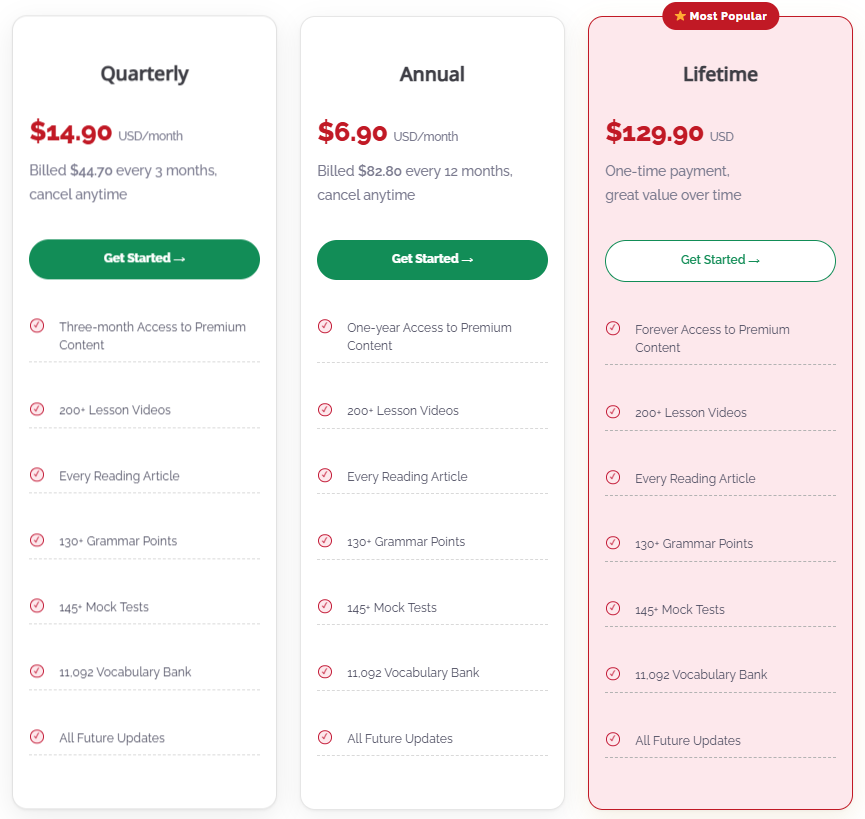
    Compared to Duchinese, the price is way reasonable.

    Price as of Dec 2023

    Final Thoughts

    In the realm of Mandarin learning resources, MandarinBean stands out as an affordable alternative to pricier options like DuChinese. Its combination of engaging graded reading lessons, practical grammar exercises, and comprehensive test preparations make it a one-stop-shop for Mandarin enthusiasts. Whether you’re a novice or a seasoned learner, MandarinBean’s user-friendly interface and quality content make it a valuable addition to any language learning arsenal.

    The only thing that I could wish for is that Mandarinbean to have it’s own app. The site is of course accessible from my phone but the format isn’t as attractive as Duchinese reading app, which is a bummer. But not a deal breaker.

    So, if you’re ready to elevate your Mandarin learning experience without breaking the bank, give MandarinBean a try. Your journey to mastering Mandarin just got a whole lot more interesting.

  • Preply or iTalki

    I have used both the learning platforms for learning 2 different languages for some months now. Preply for Mandarin and iTalki for Hungarian.

    They are both online platforms for finding a personal tutor who can help you in your language learning journey. Both similar in a way that you can choose when you want to be tutored. I love the fact that it is very flexible and very convenient than finding someone locally.

    What I think of iTalki:

    Let’s start with the good parts. Easy to use website – It’s pretty standard and very easy to find what you need. The tutor of your choice may offer discount packages – you can opt to buy a package of few hours lessons that you can use anytime, instead of paying by the hour. This way you save a bit more.

    There are quite many teachers to choose from and languages that you can learn. Even the not so popular languages. Like Javanese or Esperanto. They also offer an option for group lessons. So far they only have those for English, Japanese and Spanish. The teacher provides the level, the time and cost, and you can choose if you’d like to participate. It is much more of a group conversational practice I believe. There is also the ‘Community’ area where some tutors would share some language quizzes and you can try them out to test your knowledge.

    So those are the good things about italki that I rather like.

    Now, what I do not really like about the site is that you can only cancel or reschedule your classes within 24 hours. Well, I do think it is reasonable to give notice for the tutor to schedule something else in their lives, 🙂 but still I do not like it too much.

    It seems pretty complicated to get a refund or transfer the credit to another teacher if you are not satisfied with the current one. Especially when you bought a discount package. If you cancel before you can use up all the credits from the package then you would have to pay in full the lessons that you had earlier. Which means that you will get less refund as they deduct that from the balance.

    What I think of Preply:

    Just like italki the website is also easy to navigate. I also like the concept that you can pay for monthly subscription of 1 to 5 hours a week. So monthly it will just charge you automatically and you will get the balance hours in your ‘wallet’ to schedule. I usually subscribe for 2 hours a week.

    There are many teachers to choose from to learn. I think there are about 48-49 languages. Further, you not only can find tutors for languages but also for other things as well e.g. Python, Web design, Music , Maths and others.

    Easy to transfer balance from on tutor to another, in case if you are not satisfied with the current teacher and you would to have a new tutor you can easily cancel and transfer the balance to book the time with another teacher. Which I had done a couple of times.

    I like that you can cancel or reschedule up to 4 hours to the time of the lesson. I usually would tell the teacher at least a day before but there are sometimes unforeseeable things like when I was out and thought in the end that I may not be able to get back in time, it was really good that I could reschedule even then.

    Now, what I don’t really like is the subscription option is not very flexible. I could not simply pause my subscription to a later date because I have an excess of monthly hours right now. When I would rather change the charging period to a later date till I can use up my hours, but I have to cancel my subscription instead and renew it later. Not a big deal, but it would have been better. 🙂

    Preply or iTalki?

    I would have to say Preply here. Though both websites are easy to use but Preply had never given me any problems which iTalki had when I just couldn’t enter the ‘classroom’ a few times. Until I used a different browser.

    I feel that Preply gave me more flexibility – when I need to reschedule or when I needed to transfer the credits to another teacher.

    In case you’d like to give it a try yourself you may sign up using my referral link and get 70% off your first lesson. Click here

    Hope this helps and thanks for reading!