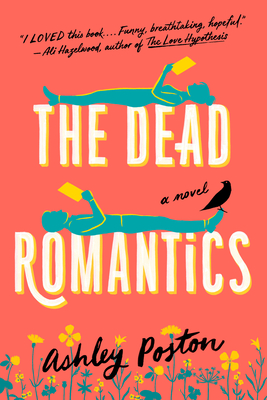
Florence Day is a ghostwriter for a famous romance novelist, which is rather unfortunate because she has stopped believing in romance herself. After a bad breakup, she is struggling to finish the final book in her contract, and her new editor, Benji Andor, refuses to give her the extension she desperately wants. Then Florence’s father dies, sending her back to the small town she left behind and to the family funeral home where she grew up. There is one other complication: Florence can see ghosts. And not long after she gets home, Ben turns up at the funeral home — apparently dead.
That premise was actually what attracted me to the book. I had already thought of The Ghost and Mrs Muir when I read the description: a living woman developing a relationship with a dead man who cannot really be part of her ordinary life. The circumstances are different, of course, but the idea itself did not feel particularly new to me. Still, The Dead Romantics tells its story well enough that I enjoyed reading it, especially once Florence and Ben began spending more time together.
The part that worked best for me was the yearning. There is a scene where Florence and Ben talk about how different things might have been if they had met earlier, before he “died,” and that was probably the part that got to me most. They clearly like each other, but as far as they know, they have met too late. That sense of “if only” worked much better for me than the actual mystery of whether Ben was really dead.
Unfortunately, I guessed fairly early that Ben was not actually dead. He kept disappearing without properly explaining where he went, and there were little things that made me wonder whether he was actually lying somewhere unconscious and hearing people around him. Once that possibility occurred to me, I could not really unsee it. So when the reveal eventually came, my reaction was less “Oh!” and more “Yep.” I also noticed things about the ghost rules that did not always seem completely consistent, which made me pay even more attention to how the supernatural side of the story worked.
Another thing that increasingly pulled me out of the book was how deliberate the diversity began to feel. Florence’s brother is gay, her sister Alice eventually gets together with her female best friend Rose, and there is also a nonbinary character using they/them pronouns. Any one of those characters on their own would not have bothered me. But when they kept appearing within the same relatively small cast, I became conscious of the author assembling a very specifically representative group of characters rather than simply meeting people in a story. By the time Alice and Rose were heading in that direction, I had already guessed that too. I was half-expecting a disabled Black lesbian trans woman to appear next just to make sure there was no diversity box left unticked. It may sound harsh, but that was genuinely the point at which the representation stopped feeling organic to me and started feeling constructed.
And that is probably my main problem with The Dead Romantics: I could see too much of the machinery behind it. I could see where the central twist was going, I could predict at least one of the relationships, and some of the contemporary-romance ingredients felt as though they had been deliberately put into place because this is what a modern romance novel is expected to contain. At the same time, I cannot call it a bad book. The premise is good, the storytelling is engaging, Florence’s grief over her father gives the story more emotional weight than just the romance, and I genuinely enjoyed the relationship between Florence and Ben while they believed their situation was impossible.
So three stars feels right to me. There was enough here that I enjoyed, and I certainly do not regret reading it. But it was also predictable enough — and occasionally calculated enough — that I could never completely disappear into the story.