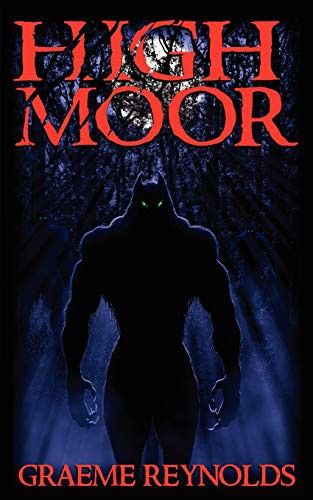
I have a fairly simple requirement when I pick up a werewolf book: I want the werewolves to actually be monsters.
Not brooding supernatural boyfriends. Not an excuse for a romance involving mates, destiny and somebody growling possessively every three pages. I want claws, teeth, bad decisions and people having a genuinely terrible time when the moon comes out.
High Moor delivered that.
This is proper werewolf horror. It is violent, sometimes gruesome, and doesn’t try to make its creatures attractive. There is something much more unsettling about a werewolf story when becoming one feels like a curse rather than an upgrade.
What I particularly liked was the atmosphere. There is a roughness to the story that suited it. It isn’t elegant gothic horror with beautiful monsters wandering around dramatically in the moonlight. These things are dangerous, and when the violence starts, Reynolds doesn’t make it pretty.
I listened to the audiobook, narrated by Chris Barnes, and his Scottish accent added enormously to the experience for me. It gave the narration the kind of rough, distinctly British character that the story needed and provided the immersion I was looking for. This was one of those cases where the narrator didn’t simply read the book – his voice became part of how I remember it.
I tore through it remarkably quickly. There were a few places where I thought the story could have been tighter, which is probably what kept it at four stars rather than five for me, but I was never bored.
And perhaps the clearest indication that it worked: almost immediately afterwards I started Moonstruck, the second book.
For anyone looking for a werewolf novel that belongs firmly on the horror shelf rather than the paranormal-romance shelf, High Moor is very much worth a look.
Alright, so around July 2022, I decided to switch things up in my Mandarin learning routine and gave Preply a shot – the online tutoring gig. After flying solo in the world of Chinese characters for years, I figured it was time to bring in a real pro to help me out. Fast forward a year, and here’s the lowdown on how Preply’s been my wingman, helping me tackle HSK 3 and prepping for HSK 4 in the year ahead.
Why Preply? Well, firstly, it won me over with its budget-friendly prices. Learning Mandarin on a dime? Preply’s got your back. The cost factor made it a logical choice for me to link up with a native-speaking tutor without draining the wallet.
So, every weekend, I’ve been hanging out with my tutor for about an hour per session. The pocket-friendly nature of Preply allowed me to stick to this routine, making my Mandarin learning journey feel like a walk in the park. My tutor, the Mandarin maestro, has been guiding me through the language labyrinth, giving me structured lessons and, most importantly, helping me get the hang of conversations.
Oh, and did I mention I aced HSK 3 with my tutor? Yep, no official exams yet, but the mock exams were smooth sailing. Looking ahead, I’ve got my eyes on HSK 4 like it’s the next challenge. This time I’m going for the real exam, the one in July.
And let’s talk about the practical side – talking! Preply isn’t just about lessons; it’s about real-life convos. Even if, with my tutor, I’m just reading from the lessons, but there are always opportunity to have simple conversations. It’s a much needed language workout – flex those speaking muscles, you know?
In a nutshell, Preply’s tutor has been the reliable guide I needed in this Mandarin journey. From HSK 3 wins to gearing up for HSK 4, it’s been a journey. Props to my tutor and the reasonable pricing – you guys are the real MVPs. Looking forward to what the next year brings!
Embarking on a journey to learn Mandarin can be both thrilling and daunting, especially when faced with the myriad of resources available. Having relied on DuChinese for the past year, the recent price hikes left me in search of a more budget-friendly alternative that still delivered quality content. Enter MandarinBean—a hidden gem that has not only exceeded my expectations but has become an integral part of my Mandarin learning journey.
Graded Reading Lessons: A Breath of Fresh Air
One of MandarinBean’s standout features is its extensive collection of graded reading lessons spanning from HSK 1 to 6. Each lesson is meticulously crafted to cater to learners of varying proficiency levels. What sets MandarinBean apart is its engaging approach to teaching. The lessons, presented in a blog format, are not only informative but also intriguing, making the learning process enjoyable. It encourages interaction, allowing learners to comment and engage with each lesson, fostering a sense of community among Mandarin enthusiasts.
The inclusion of both traditional and simplified versions of Hanzi, along with toggleable pinyin, provides a comprehensive learning experience. Whether you’re a beginner navigating the basics or an advanced learner seeking a challenge, MandarinBean’s graded reading lessons offer something for everyone.
Grammar Points with Exercises: A Practical Approach
Mandarin grammar can be a maze for learners, and MandarinBean excels at simplifying complex concepts. The platform seamlessly integrates grammar points with interactive exercises, allowing users to reinforce their understanding through practical application. This hands-on approach sets MandarinBean apart, transforming grammar from a tedious task into an accessible and manageable aspect of the learning journey.
Test Preparations: Elevating Your Proficiency
For those aiming to test their Mandarin proficiency, MandarinBean offers an array of test preparation materials. From HSK exam preparations to custom quizzes, the platform ensures learners are well-equipped to tackle assessments with confidence. The inclusion of detailed explanations and insights enhances the overall learning experience, making test preparations less intimidating.
The Free Package: Quality Without the Price Tag
One of the most appealing aspects of MandarinBean is its commitment to providing quality content for free. Graded reading lessons, grammar points, exercises, and test preparations are all accessible without spending a dime. Well, with a bit of limitation of course.
Premium Perks: A Worthwhile Investment
While MandarinBean’s free offerings are substantial, opting for the premium upgrade proves to be a worthy investment. The nominal cost opens up additional features, such as the ability to save progress and gain exclusive access to test preparation materials. For the serious Mandarin learner, the premium subscription provides a seamless and personalized learning experience.
Compared to Duchinese, the price is way reasonable.
Price as of Dec 2023
Final Thoughts
In the realm of Mandarin learning resources, MandarinBean stands out as an affordable alternative to pricier options like DuChinese. Its combination of engaging graded reading lessons, practical grammar exercises, and comprehensive test preparations make it a one-stop-shop for Mandarin enthusiasts. Whether you’re a novice or a seasoned learner, MandarinBean’s user-friendly interface and quality content make it a valuable addition to any language learning arsenal.
The only thing that I could wish for is that Mandarinbean to have it’s own app. The site is of course accessible from my phone but the format isn’t as attractive as Duchinese reading app, which is a bummer. But not a deal breaker.
So, if you’re ready to elevate your Mandarin learning experience without breaking the bank, give MandarinBean a try. Your journey to mastering Mandarin just got a whole lot more interesting.
Since June, I’ve been on a digital journey with Everand, Scribd, and Slideshare. These platforms have become my go-to for everything from reading to sharing docs and jazzing up presentations. Let me share why this trio is my internet happy place.
Everand is my not-so-secret weapon for diving into ebooks and audiobooks without burning a hole in my pocket. From classics to the latest releases, my Everand subscription, at just $9.99 a month, gives me access to a world of stories without breaking the bank
Scribd, the sibling of Everand, is like the chill spot for documents. It’s not just official papers; it’s where the community shares all kinds of reads. Scribd keeps it down-to-earth, making the document-sharing scene feel like a laid-back hangout.
Slideshare, the funky cousin in this trio, is all about presentations and visuals. Whether you’re a student, a pro, or just into pretty slides, Slideshare is the visual party that’s part of the gang. And hey, it’s all bundled up under the same subscription.
Let’s talk subscription smarts. Everand, Scribd, and Slideshare are all under one subscription, and at $9.99 a month, it’s like having a backstage pass to the whole show. Now, here’s the cool part—I’ve decided to switch to a yearly plan at $84.99 next billing cycle. Why? On top of having unlimited ebooks and audiobooks, that’s a saving of $34.89 a year. Simple as that.
Oh, before you go, here’s a little gift for you! Dive into Everand, Scribd, and Slideshare with a 60-day free trial. Just click here to unlock the doors to this digital wonderland
Everand, Scribd, and Slideshare aren’t just websites; they’re like my digital hangouts, each bringing its own vibe. Whether I’m lost in a book, sharing docs with pals, or jazzing up my presentations, this trio’s got my back. Here’s to more digital adventures and discovering the wonders of this content-packed crew! 🚀✨
I have used both the learning platforms for learning 2 different languages for some months now. Preply for Mandarin and iTalki for Hungarian.
They are both online platforms for finding a personal tutor who can help you in your language learning journey. Both similar in a way that you can choose when you want to be tutored. I love the fact that it is very flexible and very convenient than finding someone locally.
What I think of iTalki:
Let’s start with the good parts. Easy to use website – It’s pretty standard and very easy to find what you need. The tutor of your choice may offer discount packages – you can opt to buy a package of few hours lessons that you can use anytime, instead of paying by the hour. This way you save a bit more.
There are quite many teachers to choose from and languages that you can learn. Even the not so popular languages. Like Javanese or Esperanto. They also offer an option for group lessons. So far they only have those for English, Japanese and Spanish. The teacher provides the level, the time and cost, and you can choose if you’d like to participate. It is much more of a group conversational practice I believe. There is also the ‘Community’ area where some tutors would share some language quizzes and you can try them out to test your knowledge.
So those are the good things about italki that I rather like.
Now, what I do not really like about the site is that you can only cancel or reschedule your classes within 24 hours. Well, I do think it is reasonable to give notice for the tutor to schedule something else in their lives, 🙂 but still I do not like it too much.
It seems pretty complicated to get a refund or transfer the credit to another teacher if you are not satisfied with the current one. Especially when you bought a discount package. If you cancel before you can use up all the credits from the package then you would have to pay in full the lessons that you had earlier. Which means that you will get less refund as they deduct that from the balance.
What I think of Preply:
Just like italki the website is also easy to navigate. I also like the concept that you can pay for monthly subscription of 1 to 5 hours a week. So monthly it will just charge you automatically and you will get the balance hours in your ‘wallet’ to schedule. I usually subscribe for 2 hours a week.
There are many teachers to choose from to learn. I think there are about 48-49 languages. Further, you not only can find tutors for languages but also for other things as well e.g. Python, Web design, Music , Maths and others.
Easy to transfer balance from on tutor to another, in case if you are not satisfied with the current teacher and you would to have a new tutor you can easily cancel and transfer the balance to book the time with another teacher. Which I had done a couple of times.
I like that you can cancel or reschedule up to 4 hours to the time of the lesson. I usually would tell the teacher at least a day before but there are sometimes unforeseeable things like when I was out and thought in the end that I may not be able to get back in time, it was really good that I could reschedule even then.
Now, what I don’t really like is the subscription option is not very flexible. I could not simply pause my subscription to a later date because I have an excess of monthly hours right now. When I would rather change the charging period to a later date till I can use up my hours, but I have to cancel my subscription instead and renew it later. Not a big deal, but it would have been better. 🙂
Preply or iTalki?
I would have to say Preply here. Though both websites are easy to use but Preply had never given me any problems which iTalki had when I just couldn’t enter the ‘classroom’ a few times. Until I used a different browser.
I feel that Preply gave me more flexibility – when I need to reschedule or when I needed to transfer the credits to another teacher.
In case you’d like to give it a try yourself you may sign up using my referral link and get 70% off your first lesson. Click here
Brigitte de Louroux, a noblewoman reduced to living as a servant under her cruel aunt, is mistaken by Rowland de Montville for a woman of far lower status. Deceived about who she really is, Rowland takes Brigitte away with him and treats her according to those assumptions. As the truth about Brigitte’s identity begins to emerge, hostility and coercion gradually give way to a romance that asks both characters to reconsider what they believe about…
So Speaks the Heart is not my first Johanna Lindsey. My first was Prisoner of My Desire, and that was the book that got me hooked on her work. That novel also has a very uncomfortable non-consensual dynamic, but somehow it worked for me in a way this one absolutely did not. Rowena is forced by her stepbrother into using Warrick to produce an heir, and although what she does to him is still rape, she is acting under terrible duress. When I first read it at about twenty-three years old, I also remember being struck by something I had probably never really considered before: yes, a man can be raped by a woman, even a man physically strong enough to tear her in two if he were not restrained. Warrick later turns the tables on Rowena in revenge, but the obsession between the two of them is so strong that, however messed up the relationship is, I somehow never found them completely repulsive as a couple.
Unfortunately, So Speaks the Heart gave me a very different reaction. Brigitte de Louroux is a wealthy heiress who has been reduced to living like a servant under her aunt Druoda after her brother Quintin is believed dead. When Brigitte tries to escape, Rowland of Montville mistakes her for an actual servant and takes her back. Things only get worse when Druoda manipulates the situation further and convinces Rowland that Brigitte is Quintin’s mistress, which leads to him taking Brigitte away with him under a completely false impression of who she is.
And this is where the book lost me. The words “Stockholm syndrome” kept coming to mind the more I read it. Rowland has scumbag written all over him. He sees Brigitte as someone beneath him, someone he can control and use, and the romance asks me to eventually accept that this develops into love. I simply couldn’t.
The fact that Brigitte is actually a noblewoman does not make Rowland’s behaviour any easier for me to accept. If anything, it makes the whole thing worse. He has already shown me how he is prepared to treat a woman when he believes she is beneath him. Finding out later that she has the “right” social status does not suddenly make him a better man. As the saying goes, when someone shows you who they really are, believe them. Rowland showed me. I believed him.
Brigitte frustrated me as well. I wanted considerably more resistance from her than I got, especially considering how strongly the story initially presents her as someone determined not to be anyone’s slave. Instead I spent too much of the book wondering why I was supposed to root for her attachment to this man. With Rowena and Warrick in Prisoner of My Desire, however twisted their circumstances were, I could understand the attraction and obsession. Here I mostly wanted Brigitte to get away from Rowland.
Perhaps this is simply one of those older bodice-ripper romances whose hero-heroine dynamic has aged particularly badly for me. I can tolerate a lot in fiction when the chemistry convinces me, but this one never managed that. Instead of passionate, I found the relationship unpleasant; instead of romantic, it felt disturbingly close to Stockholm syndrome.
Not my cuppa tea. I honestly could have given this one star. The second star may simply be because it is Johanna Lindsey, and I know from Prisoner of My Desire that she can make even a completely outrageous premise work for me.
I have been a fan of the “choose your own ending” text-based games and romance novels for a long time. So this genre is just perfect for me. It is the only kind of game that won’t take me years to finish. Just like how I would read books right before bed, I would read a visual novel on the switch instead.
The first Visual novel game I tried on the switch is “Bustafellows”. It is a noir mystery crime busting visual novel. Here you will play as ‘Teuta’ or what ever name you choose to give the girl protagonist. I am not even sure if it can be considered a game because you get to make very few choices. Some chapters would go on without you having to make any choices at all in fact. Few but important choices that would determine which route you will take and which Love interest you would end up with.
What I like about this visual novel is that, there are many stories to unfold. Good endings, bad endings, and side stories as well. The character designs are nice as well in my opinion. My Love interests here are Shu and Limbo. The least being Scarecrow and Helvetica. I suppose because the characters of the first two guys I mentioned are not over the top. I also enjoy the good endings for sure.
Now what I do no like much about it is that the stories can be pretty dark. There would be some mention of ‘suicide’, ‘violence’ and ‘murder’. Heck it is after all a mystery crime novel after all, but I wasn’t expecting it to be a little disturbing to be honest. So I would usually go over the bad ending first and later go for the good ending to clean my system with more positive emotion.
All in all, I thoroughly enjoyed it and would definitely recommend to anyone getting into visual novels. Out of 5, I would give it a 4.5. 👌
From Goodreads: The title of the series is Simple Hungarian, for the stories are told in simple, everyday colloquial style.
I have to admit that I got this book a while back and started reading it long ago only to put it aside for a long time. I began to read the book again since I started to brush up on my Hungarian. I just need something else to read other than the text books that I am using.
If you are learning Hungarian like myself you would know that there aren’t many study resources out there for this language compared to other languages; say Japanese or Spanish. So when I saw this book I was glad.
Well, despite what the title says, “Simple Hungarian”. There is nothing simple about Hungarian. 😀 But just like everything the more you expose yourself to it the easier it gets. I find that the book is good for learning new words and also helps you remember the basic concepts and words usage as they are repeated a lot. It kind of ease you into the language.
The book is divided into 2 parts – Simple present and simple past. Each part comes with 50 short articles or topics. The topics are about common things that you would use in your daily life with topics like – family, friends, siblings, work, hobbies etc. The topics were actually repeated in both parts but as I mentioned earlier, one is presented in simple present and the other in simple past. And at the end of each topic there are questions based on it. Also the translations of both the articles and questions are provided as well. So you can use the questions to try to repeat what you’ve read by memory.
This book is not something you can use as a textbook for sure but definitely something you should consider getting as a supplement for language learning.
From Goodread: It’s 1948 in Rippling Creek, Louisiana, and Tate P. Ellerbee’s new teacher has just given her class an assignment–learning the art of letter-writing. Luckily, Tate has the perfect pen pal in mind: Hank Williams, a country music singer whose star has just begun to rise. Tate and her great-aunt and -uncle listen to him on the radio every Saturday night, and Tate just knows that she and Hank are kindred spirits. Told entirely…
I finished this book about a week ago. I just didn’t have the time to write my thoughts on it. I am a fan of ‘letter writing’ or ‘journaling’ story telling. Not surprising that one of my all time favorite books “daddy long legs” by Jean Webster. You kind of get into the head of the characters and it can make them seem much more real.
It took me a few hours to go through this book. I love reading stories from the perspective of a child. Innocent ,funny and refreshing. The story is based in the late 1940 post II world war period and the story was told through letters sent by an 11 year old girl named Tate P. Ellerbee to her idol, Hank Williams. I have to confess that every time she mentioned a song, I had to look it up and listen to them while reading the book. It was well written that I could imagine rather vividly how it was to live as a child in the 40s. How much more simple and complicated it was at the same time. Now when I wanted to listen to a song I could just google it or look it up on ‘spotify’ or ‘Tidal’ and chances are I would find them there. But for a child in the 40s who wanted to listen to songs of their favourite singers, they would have to make time to tune it to the radio at certain time of the day with the entire family. If you missed it, you miss it. You just have to wait for the next day or week for the program to come up again on the radio. I suppose something that we modern people would not have to go through – everything is instant gratification these days.
Anyway, it all started when her teacher decided that they should all start writing to penpals. And Tate, after listening to Hank Williams for the first time on the radio, had a good idea of who her penpal should be – which is Hank Williams himself, and nothing her teacher told her could convince her otherwise. From then on she started to relate the daily going ons in her life religiously through letters – without getting a reply of course other than the occasional autographed photos.
As I mentioned earlier, the letters were well written, peppered with childish humor, and curiosity. It is a story about love, family and grief. I conveyed in the end of how a grieving child might see the world. It reminded me that nobody is safe from the harsh reality of living. Not even a child. But love and hope conquers all and makes it easier what ever hardships life throws at us.
With this I have to say that I thoroughly enjoyed the book and recommend it for sure.
Spoiler warning: This review discusses the ending of the story.
I read The Ghost and Mrs Muir after watching the 1947 movie, and from what I remember, the film was actually quite faithful to the book. That probably helped because I already knew the characters and the general shape of the story, but I still enjoyed going back to the original novel and seeing where it all began.
Mrs Muir is a widow with very little money, and that is partly what makes Gull Cottage possible for her. The house is cheap because it has a rather inconvenient problem: it is haunted by its former owner, Captain Daniel Gregg. Most people would probably leave the moment they realised the ghost stories were true, but Mrs Muir does not really have that luxury. She needs somewhere affordable to live, and apparently sharing a house with an irritable dead sea captain is a problem she is prepared to deal with.
Captain Gregg has managed to frighten other occupants away, but Mrs Muir refuses to cooperate. She is stubborn enough to stay, and eventually he has to accept that she is not leaving. I think that is one of the things I liked most about their relationship. Neither of them gives in easily, and what begins as an argument over who has the greater right to the house slowly develops into companionship and affection.
I do not remember every detail of what happens in the middle of the book now, but I remember the relationship between Mrs Muir and the Captain very clearly. It is such an unusual romance because the problem between them can never really be solved while she is alive. They can talk, argue, care for one another and become important parts of each other’s lives, but they cannot have an ordinary future together.
That is what makes the ending so bittersweet. Mrs Muir eventually grows old and dies, and Captain Gregg has waited for her all those years. When he comes for her at the end, they can finally be together without the barrier that had always existed between them.
It is sad because an entire lifetime has had to pass first, but at the same time I cannot imagine the story ending any other way. There is something very moving about the idea that he simply waited until her life was finished.
Despite being a ghost story, The Ghost and Mrs Muir never felt frightening to me. It is much more about companionship, loneliness, independence and a love that has to wait far longer than most.
I watched the movie first, but reading the novel afterwards did not spoil either version for me. If anything, they complemented each other, and I can understand why this story has lasted as long as it has.